Chile is entering a new political phase as a right-wing government prepares to take office, putting mining policy under renewed scrutiny in the world’s largest copper-producing country.
In recent years, the local politics have also been shaped by rising concern over crime and migration, particularly a surge in Venezuelan migration and highly visible organized crime. While the causes are complex, perceptions linking irregular migration and insecurity became politically potent. President-elect José Antonio Kast, who takes office on March 11, campaigned on stricter border control and tougher law-and-order policies, making security a central issue in Chile’s electoral shift.
Kast has also signalled a change in approach for the mining industry. He merged the ministries of Mining and Economy into a single portfolio and appointed Daniel Mas, an agronomist with no mining background, to lead it. In a country where mining underpins economic growth, labour and export revenue, the move has unsettled parts of the industry.
Carlos Piñeiro, copper analyst at Benchmark Mineral Intelligence, said the fusion could improve coordination but risks diluting mining-specific expertise. “Mining has very particular challenges, especially the non-renewability of resources,” he said. “If this model is going to work, specialists need to be involved in decision-making.”
The Chilean Mining Chamber was more critical. “Mining, despite being our national emblem and the activity that contributes the most resources to the public purse, is treated as second-rate,” chamber president Manuel Viera told MINING.COM.
Viera said the Chamber would have preferred a minister dedicated exclusively to mining, noting that previous experiences placing mining under broader economic portfolios “have not been positive.” While he does not foresee governance risks due to the sector’s maturity, he said mining’s success depends on technically grounded public policy rather than political decisions.
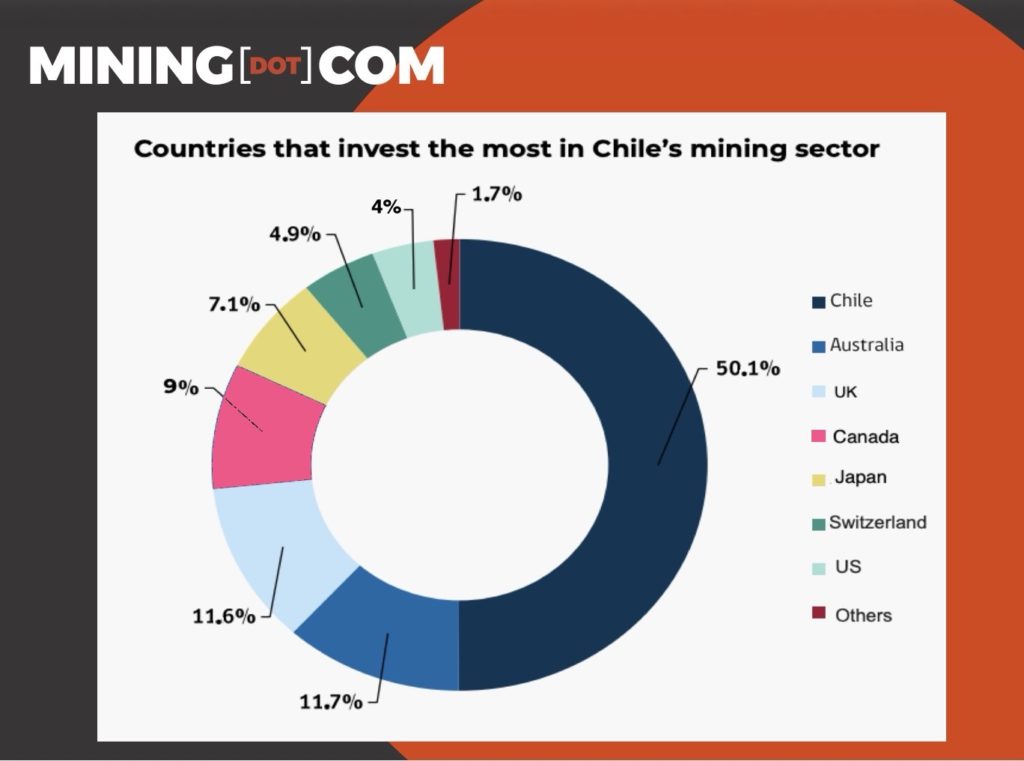
Mas takes charge of a sector that is expected to attract an estimated $105 billion in investments between now and 2034, alongside proposed reforms to permitting and environmental assessment frameworks that companies say have slowed approvals and raised costs.
Eduardo Zamanillo and Marta Rivera, authors of the book Mining is Dead. Long Live Geopolitical Mining, said the merger of the ministries sent an important institutional signal at a time when major economies are placing critical minerals at the centre of industrial and security strategies.
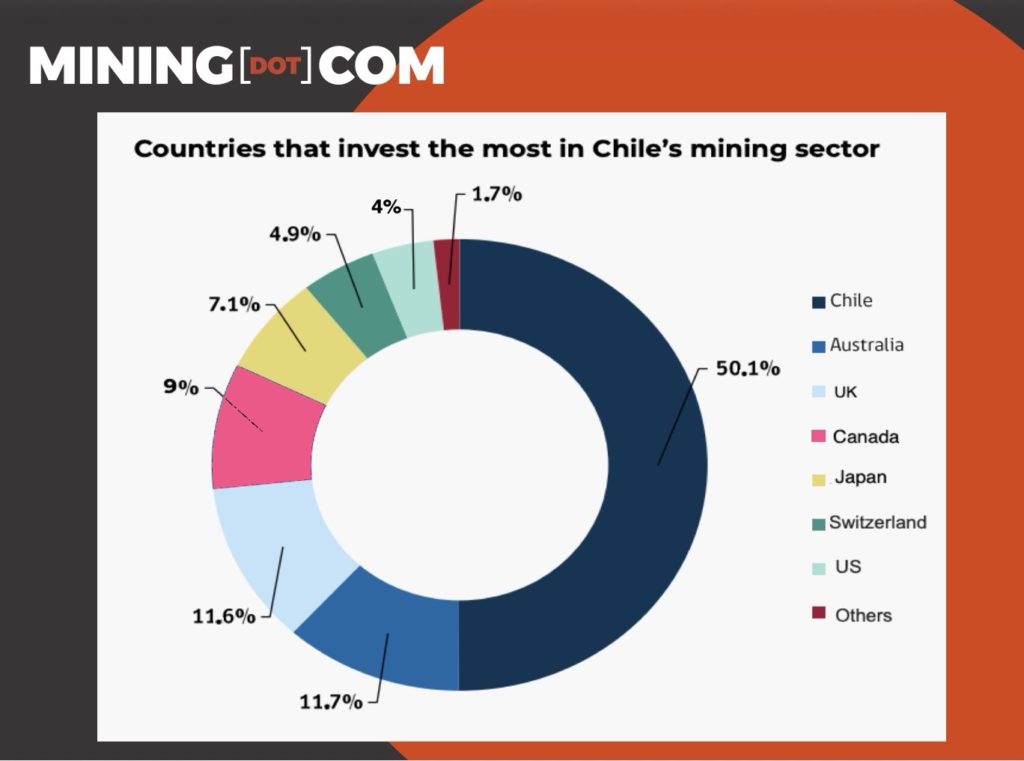
Although Chinese ownership of Chilean copper mines is limited, Beijing maintains influence through trade, financing and equipment supply. At the same time, US trade policy and Inflation Reduction Act-linked investment aim to anchor Chile more firmly within allied supply chains.
From a geopolitical mining perspective, Zamanillo and Rivera argue the move could either integrate mining more deeply into industrial policy, trade and innovation, aligning Chile with US-led reindustrialization efforts, or dilute the sector if it becomes just another file within a broad portfolio. In their view, Chile’s opportunity lies in treating copper and lithium not merely as extractive revenues, but as platforms for building full value chains tied to allied markets. Whether the merger strengthens or weakens Chile’s position will depend on political will, technical leadership and the clarity of its long-term strategy.
Mineral ambitions meet execution risk
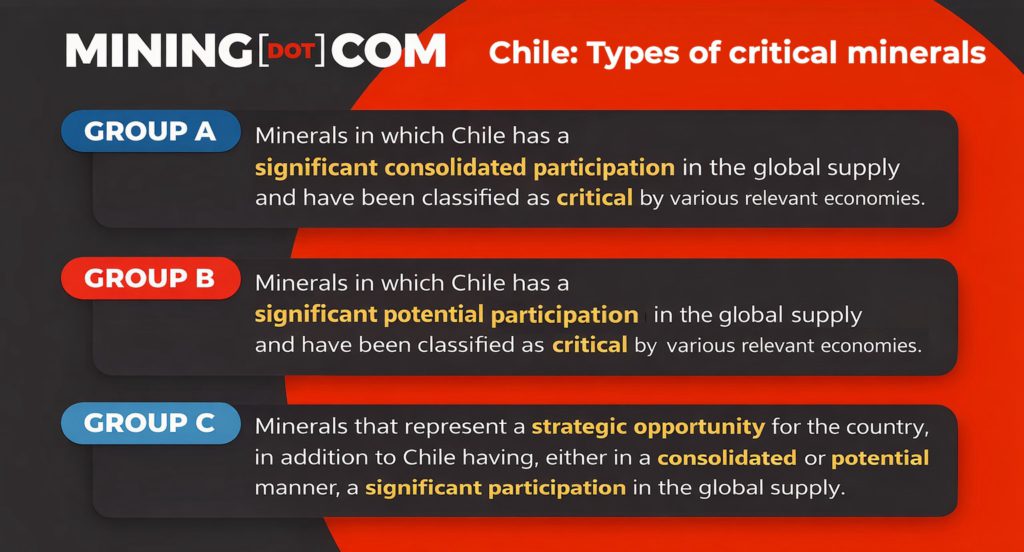
Chile’s policy debate has been further shaped by the release of the country’s first critical minerals strategy in the final weeks of outgoing President Gabriel Boric’s administration. The strategy aims to position Chile as a supplier not only of copper and lithium, but also of 14 other minerals considered essential to the energy transition and resilient supply chains.
Beyond copper and lithium, the list includes molybdenum, cobalt, rare earth elements, antimony, gold, silver, iron ore and boron, to reduce Chile’s historic over-reliance on a single commodity.
Viera said diversification is not optional. “Depending almost exclusively on copper exposes the country to market cycles and uncertainty,” he said, noting that copper accounts for around 11% to 12% of GDP and more than 20% when considering economic impacts and multiplication effects. While copper will remain the backbone of the economy through at least 2035, he said minerals such as lithium, gold, molybdenum, rhenium and rare earth elements must help reduce long-term risk.
Piñeiro said Chile’s mining base is already broader than often assumed, citing molybdenum, rhenium, lithium, iodine, nitrates and a recovery in gold output. He added that projects such as Salares del Norte could lift national gold production by about 25%.
The strategy groups minerals according to Chile’s current position in global markets, with copper, lithium, molybdenum and rhenium in the top tier, and cobalt, rare earths, selenium and tellurium among longer-term options.
According to Viera, Chile’s challenge is not geology but policy. “The resources exist,” he said. “What is missing is a promotional and development plan that encourages exploration, investment and production.”
Others remain cautious. Daniel Weinstein, partner at Morales & Besa and president of the Mining Ministry’s advisory council, said the strategy provides a framework but does not change investment conditions on its own.
“Cursed” permitting system
José Cabello, director of Mineralium Consulting Group, said the critical minerals plan lacks concrete near-term measures. “Nothing in the document implies a definitive boost to Chile’s production of these minerals,” he told MINING.COM, pointing to the absence of clear decisions to advance early-stage projects.
Viera echoed those concerns, arguing that without incentives for exploration and faster permitting, Chile risks missing the current price cycle. He described the permitting system as “cursed,” noting that a single project can require more than 500 permits over several years before seeing the light.
Zamanillo and Rivera argue that diversification should not be understood only as adding more minerals to a list, but as defining Chile’s position along emerging Western critical mineral value chains.
Trade data show Chile still exports most of its copper as bulk concentrates, heavily tied to China, while a smaller share of refined copper flows to the US and other allied markets. In their view, the strategic opportunity lies in gradually shifting toward more refined output, midstream processing and higher-value services, using copper and lithium as anchors to attract investment aligned with US and allied industrial policy. Rather than relying predominantly on concentrate exports, Chile could rebalance toward deeper integration with North American value chains.
Copper dominance, rising constraints
Chile remains the world’s largest copper producer by a wide margin, accounting for roughly a quarter of global mined output. But declining ore grades, ageing deposits and rising regulatory complexity are constraining growth.
That strain is showing in production, which fell on a year-on-year basis every month of 2025. Official Cochilco figures peg the decrease in copper production last year at 2%, when compared to 2024 figures.
“Deposits are becoming deeper and lower grade,” Piñeiro said, adding that this makes Chile less competitive than jurisdictions such as the Democratic Republic of Congo, where higher grades support lower costs.
Industry groups are hoping Kast’s government will adopt a more pro-growth stance that would benefit the mining industry, but they warn that meaningful production increases will take time.
They also expect increased government involvement in the northern mining regions, such as Antofagasta and Tarapaca. These areas have seen visible irregular migration flows, heightening security concerns in areas central to copper and lithium production. Business groups have called for stronger border control and protection of logistics corridors. While core mining jobs are specialized, tighter migration rules could affect local labour markets in supporting sectors, analysts say.
Against that backdrop of regional strain, industry leaders are also focused on output and long-term competitiveness. Viera said Chile is “obligated” to exceed six million tonnes of fine copper per year, but stressed that growth must come with greater added value through industrialization. “The future lies in industrializing copper and lithium with a global perspective,” he said.
While Kast’s team has floated boosting mining output by as much as 20% within a year or two, council executive chairman Joaquin Villarino has said Chile’s project pipeline would more realistically lift copper production to around seven million tonnes over the next decade, assuming permitting efficiency and sustained investment.
Mariano Machado, Americas analyst at risk intelligence firm Verisk Maplecroft, said the 20% target is a political signal, not a literal schedule. “It signals urgency, not an immediate step change,” he said, noting Chile’s constraints stem from mature assets and long lead-times.
Machado pointed to Cochilco’s own projections, which show output peaking mid-decade before drifting down toward around 4.4 million tonnes by 2034. “We expect the sector to discount the headlines and watch what Kast can change early, including faster permit decisions and fewer procedural pauses,” he said.
From Zamanillo and Rivera’s perspective, Chile’s fundamentals remain strong in a world where capital is mobile and increasingly shaped by geopolitical considerations. They note that large pools of public and private funding in the United States and allied countries are being directed toward critical mineral supply chains, including reserves, loans and equity instruments. For Chile to compete with both other jurisdictions and high-growth sectors, they argue, it must shorten and clarify permitting timelines.
Long-life copper and lithium projects need predictable rules and sovereign speed, they say, if Chile wants to capture a larger share of the capital now being mobilized under the new critical minerals architecture.
More broadly, the nation’s shift toward a tougher law-and-order agenda shapes perceptions of regulatory certainty and state authority. For foreign copper and lithium investors, that trajectory feeds directly into risk assessments, even if migration itself is not tied to production.
Lithium: cost advantage, policy uncertainty
Chile remains the world’s second-largest lithium producer but has lost market share to faster-growing rivals. A national lithium strategy unveiled in 2023 increased state involvement and reshaped project development pathways.
Piñeiro said Chile’s cost advantage remains significant, citing the Atacama Salt Flat as one of the lowest-cost lithium brine resources globally.
Viera argued the country’s loss of leadership in lithium is political rather than geological. He added that Mining Code restrictions reserving lithium for the state have discouraged private investment despite high-quality reserves.
Machado said investor confidence in lithium hinges less on signed agreements than on operating stability. “A deal is the easy part — a stable licence to operate is harder,” he said, noting that investors still price in political and social constraints.
While the Supreme Court’s backing of the Codelco and SQM (NYSE: SQM) agreement removed a legal challenge, he noted that investors continue to price in political and social constraints. “Chile’s advantage matters if it can offer a stable operating model that survives social scrutiny and electoral cycles,” he said.
According to Viera, Chile could regain its position as the world’s largest or second-largest lithium producer within the next decade if restrictions are repealed and a pro-investment framework is adopted. He cited projects such as Nova Andino Litio, a joint venture between Codelco and SQM, and Salares Altoandinos as positive steps, but said far greater potential exists across more than 40 salt flats nationwide.
There is also Codelco’s Maricunga lithium partnership with Rio Tinto (ASX: RIO), which is still awaiting antitrust approvals from regulators in Chile and China before the companies can move ahead and sign a shareholders’ agreement.
A credibility test
As Kast’s government prepares to take office, Chile’s mining sector stands at a crossroads. Demand for copper, lithium and other critical minerals continues to rise, but investors are focused on whether political realities, regulatory reform and their execution will align.
For the Chilean Mining Chamber, the central issue is credibility. Viera said Chile must boost exploration incentives, modernize its smelting capacity and position mining as a strategic driver of development, not a fiscal fallback. He added that the new Minister of Economy and Mining could play a pivotal role. “For more than 15 years, Chile has not launched any new projects to increase copper production. The only initiatives have replaced depleted reserves,” Viera said. “The country needs a nationwide exploration policy… Without new discoveries, we will fall behind.”
For Machado, credibility rests on delivery capacity, not rhetoric. He said the clearest signal would be a delivery framework that promotes productivity and talent, positioning mining as a modern export platform. He pointed to the Critical Minerals Strategy’s call for redesigned curricula, new specializations and stronger integration between industry, academia and the public sector.
That focus aligns with Chile’s broader competitiveness diagnosis, which highlights a persistent mismatch between available skills and labour-market demand. Machado noted that the mining workforce is already structurally tight and increasingly contractor-heavy. “A robust plan for developing human capital is not an add-on, but a necessity to mitigate capex risk,” he said.
In an increasingly geopolitical minerals market, Chile’s challenge is no longer just the size of its resource base, but whether it can reliably convert that advantage into sustained supply.
———
Latin America is heading into 2026 with resources at the centre of a growing global power struggle, as governments and investors focus on who controls critical minerals and the supply chains behind them. If the region matters to you, don’t miss MINING.COM’s new series tracking the geopolitical forces reshaping it and why markets are increasingly driven by global alliances as much as local politics.